• Activ Right Brain
  • About Dean
  • Designing The Future
  • Speaker
  • Keynotes
  • Blog
  • Art
  • Contact

activrightbrain

  • Activ Right Brain
  • About Dean
  • Designing The Future
  • Speaker
  • Keynotes
  • Blog
  • Art
  • Contact

Rise of the Machines

Robots: Who doesn't love the idea of a humanoid personal assistant with artificial intelligence, laser eyes and the ability to preempt your every move? No, wait…

2015 is the year of wearable technology, right? No, that was last year. This year wearable tech beds in and gets on with the real job in hand. The 2015 buzz surrounds robots of all shapes and sizes.

Yesterday, I caught up with Aldebaran at CES, a French company making big waves in the android marketplace. That’s ‘android’ with a small ‘A’. I first met NAO in Poland last month and loved the playful approach Aldebaran had taken to developing their first consumer robot.

Only it isn’t available to consumers yet. 10 years of refinement means developers have been the first to get their hands on the cute little chap to hone interaction and push boundaries for commercial markets. He currently responds to a set list of commands but this is then extended by the user with AI kicking in as he learns new and exciting ways to respond.

The limb articulation is particularly impressive. If you push NAO over, he struggles back to his feet in a truly human fashion. This where it all begins to get a little weird. The mere act of pushing him over makes you catch your breath, as if actually bullying a small child. You feel bad about having performed this action, merely to see see how he’ll react. And so begins the human/humanoid relationship.

Aldebaran have some exciting products in the pipeline, including Romeo, a personal assistant and companion for the medical and care industry. Humanoid robots with character can play a vital role in this area, with NAO already used in hospitals to aid rehabilitation and put children at ease in an intimidating environment.

I spoke with a number of other fascinating robotic manufacturers at CES but the tiniest was Ozobot, a cute little droid that (in their words) “teaches robotics and coding through fun, creative and social games”. I love the use of physical and digital inputs – in its simplest form, providing a pen or pixel line for Ozobot to follow across paper and tablet. The manufacturers picked up a raft of awards at CES – deservedly so.

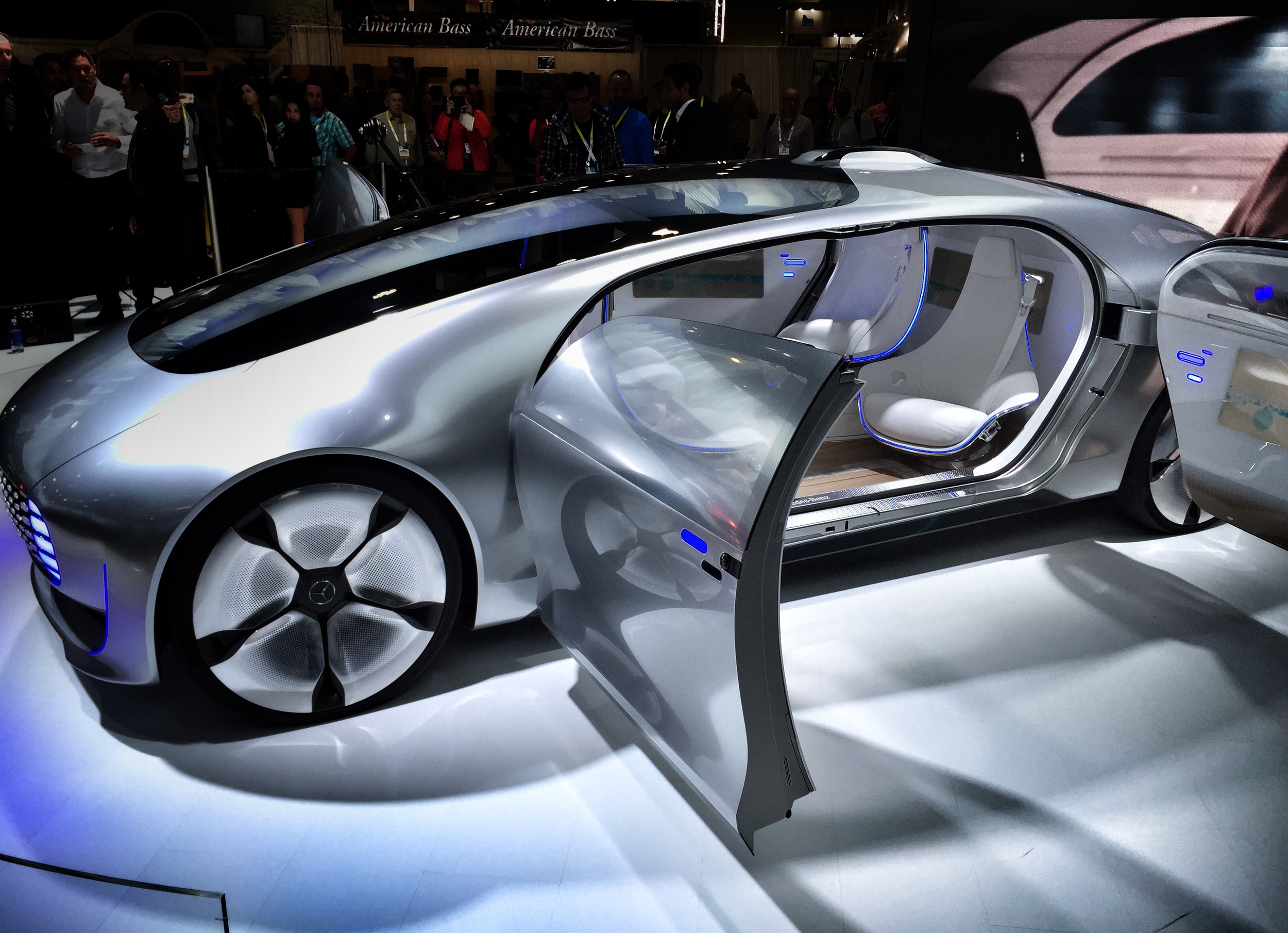
This market isn’t just for startups, Google went on a buying spree in 2014 and their ownership of robotics companies is now in double figures. Automotive manufacturers have been at this game for years. Honda and Toyota are particularly hot in this area, as Mercedes and Audi up their game at CES with autonomous cars – that kinda makes the whole car a robot!
Amazon is another big player entering the arena. They’re offering us the chance to purchase our own personal assistant, Echo, useful and worrying in equal measures – especially with its ‘always listening’ approach.

Window cleaning robots, digital sandwich board cyborgs and tiny printer droids – Vegas was wall-to-wall automatons.

Of course, robots come in all shapes and sizes, with drones also falling into this category. Now everyone wants a drone before they get legislated out of existence so grab one while you can!

If 2015 wasn’t kicking off with a big enough buzz around robots, just wait for the season climax with the release of Star Wars: The Force Awakens in December. These are the droids you are looking for.

tags: Robots, robot, cyborg, automaton, android, humanoid, Aldebaran, CES, CES 2015, #CES2015, Romeo, Ozobot, Google, Honda, Toyota, Mercedes, Mercedes F015, F015, Audi, autonomous driving, autonomous cars, Amazon Echo, Amazon, Echo, drones, Star Wars, Star Wars: The Force Awakens, Star Wars The Force Awakens, Star Wars Ep VII, Star Wars Episode VII, NAO
categories: Automotive, cars, Conference, Design, Futurology, Gadget, Innovation, Star Wars
Friday 01.09.15
Posted by Dean Johnson
 

2013: Future Fiction

What's new for design, technology and publishing in 2013? A valid question but why not resolve to make a difference, rather than predict what everyone else will do.

It's all too easy to find yourself caught up in the present, like a fly in a web, albeit a digital one in this case. Attending to clients with immediate requirements and never allowing yourself time to look further ahead than lunch or the next meeting can lead to a very blinkered approach to work and life.

Future_typewriter.jpg

I am in the fortunate position where my job specifically requires me to daydream, allowing my imagination to wander, looking beyond the present and jumping headlong into the future.

I have always loved the concept of time travel but it's not the vision of future civilisations or making history tangible that intrigues me, I'm fascinated by the impact of our actions and the rebuttal of inevitability. I don't believe in fate and I have never subscribed to the theory that our lives are in any way shape or form planned for us. If they were, why even bother to climb from our beds in the morning? Why take a different route to work? Why try to shape a business or industry for the better when the end result is written in stone.

Stephen King explored the obdurate past in his novel '11.22.63', stubbornly trying to reassemble itself into a network of intersecting lines that results in the same conclusion, the same historic path, the same planned inevitability. The challenge lies in breaking these strands to change the course of history.

OK, as the option to change the past isn't currently available to us, let's focus on the future as this lies in the hands of individuals prepared to write the history books and create 'Future Fiction'. You don't have to be an author, but someone with a passion to create a narrative for history, rather than slavishly follow focus groups or base all resources on developing multiple-choice products. In order to create and shape demand, you need to define the criteria and the product yourself.

Apple's 'Think Different' slogan is as powerful today as it was when this inspirational ad aired in 1997.

From Albert Einstein to Martin Luther King, Jim Henson to Steve Jobs himself, these were individuals with strong personalities and conviction, carving out deep impressions in the very fabric of history. 

The author Philip K Dick is a great example of a 'fictional innovator' – he gave us incredible glimpses of the future with classics such as Blade Runner, Total Recall and Minority Report. A recent comment on Twitter referred to Minority Report as pure fiction that should be treated as such. Well, we may not be exploiting precogs, but we're certainly using Tom Cruise's gestural interface. Several years ago Brandwidth worked on some stunning gestural interaction and 3D plasma screen projects for Toyota, so we've been used to keeping in line with fiction in order to keep clients ahead in the 'real world'.

2013 offers us more tools than ever before to bring the future into focus. Watch out for wearable technology and a return of gestural interfaces, powered by great hardware such as Leap and Microsoft's Kinect. When scale is important, we'll move beyond touchscreens and bring digital content into our physical environment. Don't worry, that doesn't make your smartphone and tablet obsolete, just open your minds to TVs, shop windows and car interiors that need you to wave your arms around.

This is an exciting time to make a digital difference in a physical world. Don't settle for today, when tomorrow has yet to be shaped. Get out there and write the future, don't sit back and read it.

tags: Stephen King, Apple, Steve Jobs, Minority Report, Albert Einstein, Blade Runner, Total Recall, time travel, Leap, Brandwidth, Tom Cruise, Jim Henson, Think Different, Toyota, Microsoft Kinect, Martin Luther King, Philip K Dick
categories: Automotive, Innovation, Books, Gadget, Design
Tuesday 12.18.12
Posted by Dean Johnson
Comments: 4
 

Designing the Future