• Activ Right Brain
  • About Dean
  • Designing The Future
  • Speaker
  • Keynotes
  • Blog
  • Art
  • Contact

activrightbrain

  • Activ Right Brain
  • About Dean
  • Designing The Future
  • Speaker
  • Keynotes
  • Blog
  • Art
  • Contact

A New Creative Direction

Technology is a glittering lure, but there’s the rare occasion when the public can be engaged beyond flash – if they have a sentimental bond with the product. These aren’t my words, they came from the pen of Matthew Weiner and the mouth of Don Draper (John Hamm), the Creative Director’s Creative Director and the star of AMC’s Mad Men.

CD.jpg

Don is delivering his thoughts in a pitch to Kodak for their new slide carousel and it brings tears to my eyes every time I watch. On first viewing, I felt a sense of nostalgia for the precious moments with my children growing up. More recently, my thoughts have turned to the time I failed to spend with Olivia and Hattie, having left them in their formative years. I’ve been a poor father, but I’m working so very hard to change that.

It may sound contrived to say you must have something and lose it to truly appreciate it, from family and friends to money to freedom (a reality we’re all facing during the current global pandemic) – even job titles. I can’t help but think this isn’t simply part of our ‘fail fast’ startup mentality. It has always been true.

My somewhat nostalgic view of family also extends to the profession I love – design. This might seem at odds with my role as a ‘Futuroligist’ and all the technological interaction this brings, but my boundary-pushing has always had an extraordinary depth of respect for where origins lie. 

My background combines Design, Technology and Innovation and all three should interlink to form the backbone of a contemporary Creative Director. However, Design should still be the primary focus, leading a team to creative excellence through an understanding of the tools at our disposal and the talented individuals within our sphere of influence.

We strive for future missions to Mars and beyond, fuelled by knowledge gleaned from historic human efforts to reach the surface of the moon. We design and manufacture beautiful cars, driven by decades of data taken from safety, handling and ergonomic experience. Steve Jobs gave us the future in the palms of our hands, not because he asked what people wanted but because he knew what they didn’t have. He had a greater understanding of his audience than they did of themselves and this came from observing previous human behaviour and applying this to the future – the present happened as a result.

How does this relate to Don Draper and the existence of the modern Creative Director? Last week, I took an exciting leap of faith and joined an incredible creative technology agency called Beep!, based in Poole, UK and Santa Clara, US. I had the pick of creative titles but elected to once again become a Creative Director – the Creative Director.

When I first watched the Mad Men Kodak pitch, Don became the creative hero I didn’t know I was looking for. That moment provided the approval I didn’t know I needed. It gave substance to four years of design education and decades building a professional portfolio.

To appreciate its impact, here’s the full script and the scene that breathes life into Matthew Weiner’s words:

“Technology is a glittering lure, but there’s the rare occasion when the public can be engaged beyond flash – if they have a sentimental bond with the product.”

“The most important thing in advertising is ‘NEW’. It creates an itch. You simply put your product in there as a kind of calamine lotion”

“There is also a deeper bond with the product… nostalgia. It’s delicate, but potent”

“In Greek, nostalgia literally means pain from an old wound. It’s a twinge in your heart, far more powerful than memory alone.”

“This device isn’t a space ship… it’s a time machine”

“It takes us to a place where we ache to go again. It’s not called ‘The Wheel’, it’s called ‘The Carousel’. It lets us travel the way a child travels. Round and around and back home again, to a place where we know we are loved.”

I may have something in my eye…

Artificial Intelligence, reality TV creatives and Account Execs won’t replace Designers – the world just needs to know it. The role of a Creative Director isn’t simply to say “make it bigger, make it red and move it to the left a bit”, it is to motivate, inspire and champion the very existence of design. Designers need to feel important – because they are. They also need to feel relevant and the popular opinion that “everyone’s a designer” is meaningless if there’s no distinction between a good one and a bad one.

My role as President Elect of the Chartered Society of Designers provides me with an enviable overview and understanding of the profession. It is in rude health as far as skills are concerned, but COVID has hit the job market for active design recruitment and many freelancers are also suffering hardship, slipping through the cracks without Government support.

Good news is out there. Some creative businesses are flourishing AND employing (Beep! is doing both) but this message is easily swamped by the sheer volume of negative media output. It’s more important than ever to keep telling the world about success wherever and whenever it happens.

Those of us that consider ourselves designers and technologists tell a great story about “designing the future” or “shaping the now”, but like Kodak in Don Draper’s pitch, we find ourselves creating products that capture a moment, platforms that share them or channels that allow us to comment on content. Their power lies in the very same nostalgia Don referenced.

The past, present and future all intertwine and so do our roles as creative leaders.

This is why I’m championing a direct approach that streamlines the complex and makes Creative Direction great again. Like the things we feel we’ve lost or even lost touch with, it is important to appreciate simplicity in order to cut through the white noise of contemporary life.

We’ve all had our fill of Ninjas, Gurus and Experts. And that once-simple org chart now features more layers than Photoshop. When you hit the dizzying heights of creative leadership, you discover quite a crowd at the summit. These are all existing job titles:

– Design Director

– Art Director

– Associate Creative Director

– Creative Director

– Senior Creative Director

– Group Creative Director

– Head of Design

– Executive Creative Director

– Global Executive Creative Director

– Chief Creative Officer

And I’ve probably missed a few!!

2020 may seem like the longest year on record, but more than ever… every second counts. Don Draper’s time machine offered a glimpse into what many people crave – the ability to design the future by combining an appreciation of the past and an effective grasp on the present.

The Creative Director is dead. Long live the Creative Director! 

tags: Design, Graphic Design, Beep, Beep Digital, Innovation, Chartered Society of Designers, Creative Director, Kodak, Mad Men, Beep!
categories: Agency, Apps, Digital Publishing, Futurology, time travel
Wednesday 11.11.20
Posted by Dean Johnson
 

The Digital Design Imperative

When President John F Kennedy so famously uttered the words “ask not what the design industry can do for you, ask what you can do for the design industry”, how could he have known they would be even more relevant today. Or was that Neville Brody?

DigiDesignImp.jpg

I’ve always been of the opinion that if bad Photoshopping and typography doesn’t make your blood boil then you shouldn’t be a designer. If you can sit on the tube opposite an ad featuring poorly-kerned letters or view a Frankenstein comp of a ‘lead character when young’ movie prop photo and still not twitch, you are creatively dead inside.

Slink away now if you’re unmoved by either example, or hang around and get motivated.

The role of designer has changed beyond all recognition since leaving college (it’s moved fast, I’m not THAT old). What’s graphic design then? Well it used to be relatively easy to define when ‘digital’ wasn’t in play. Brand design, brochures, editorial layouts, posters, flyers and packaging for starters.

That list still exists but most brochures are now interactive, from PDF’s to iBooks with websites either replicating or delivering the same. Great editorial layouts are still essential within tablet magazines and ebooks as the eye is arrested by the skilful juxtaposition of stunning images and intelligent typography. Posters work on various levels, from the 48-sheet variety now on many digital Jumbotrons and underground screens, to our ever-increasing screen sizes offering the scale previously reserved for printed posters. Flyers (unless from the local pizza deliver business) are emails, Facebook posts or Tweets. We’re a long way from losing packaging from our high streets and out of town stores, but the online marketplace offers many more virtually packaged download opportunities.

So, who cares? Things change, technology advances and forces us to move with it. That’s one take, leading to the sloppy Photoshop, branding and layouts that make me want to punch inanimate objects (or designers). This attitude can be brought on by creatives who don’t live and breathe design and clients who believe our computers do all the work for us.

Snap out of it and appreciate the incredible opportunities to not only design great visual experiences, but now bring them to life as incredible user experiences. The graphic design label got scrapped, welcome to the wonderful new world of design where the brief to create postage stamps became the task to build iconic icons or miniaturised album covers and book jackets, where the fight to be seen and remembered provides the ultimate pixel-pushing challenge.

Wearable technology and Smart TV will provide your new playgrounds so start thinking about future opportunities to make a design difference.

Knock down the mental barriers and apply great design thinking to everything you do. Don’t assign different standards to different work or clients – we live in a world where a local butcher can have as much global visibility as Wallmart. The world’s eyes are on your kerning, your cut-outs and your colour palette.

Originally published in Computer Arts magazine in 2013. Hasn't aged a bit!

tags: Design, technology, innovation, Photoshop, Adobe, Computer Arts
categories: Agency, Apps, Connected World, Design, Digital Publishing, Innovation, Mobile technology, Publishing
Tuesday 04.21.20
Posted by Dean Johnson
 

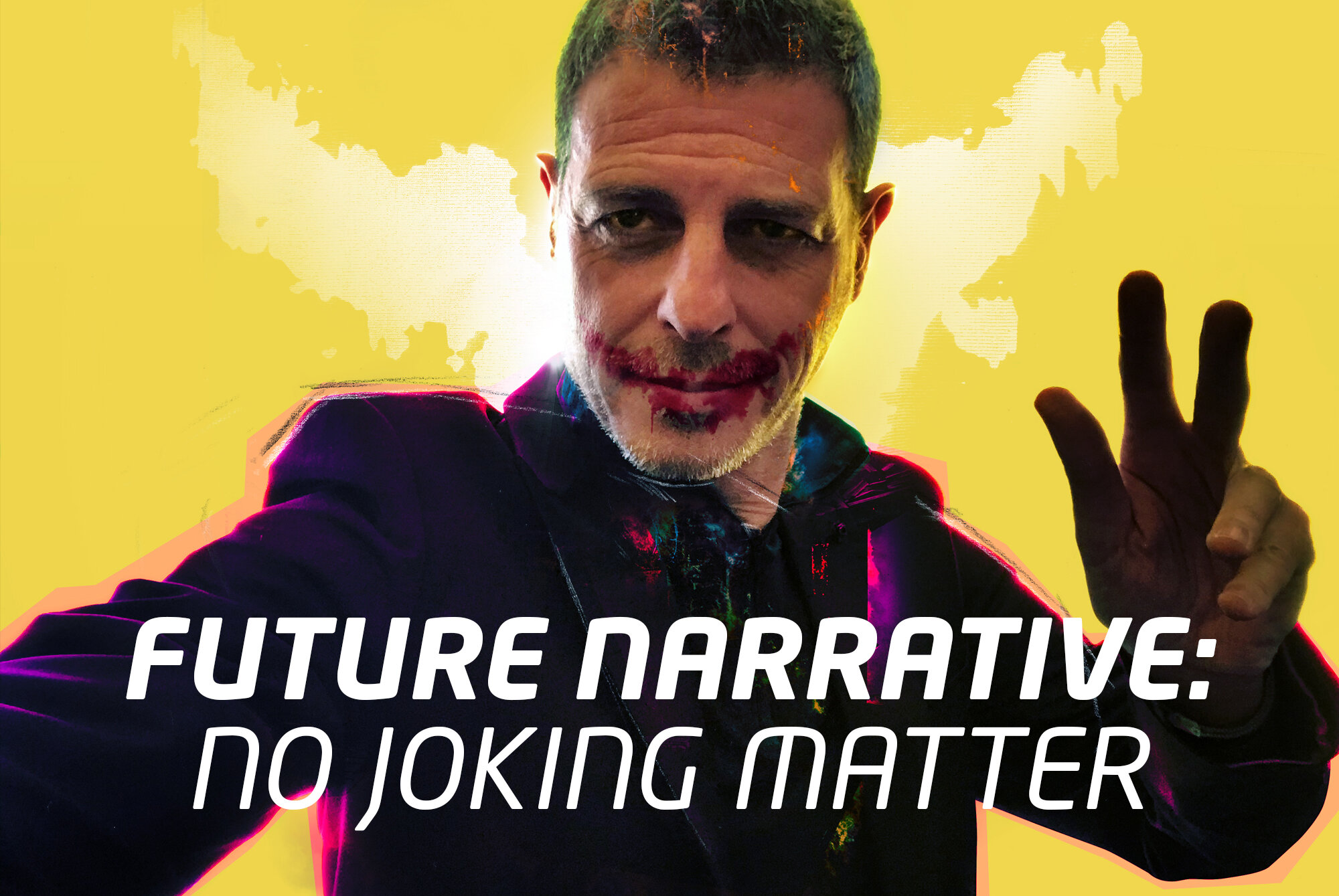
Future Narrative: No Joking Matter

The book is dead, long live the book! The film is dead, long live the film! Attention span is dead, long live social! I could go on, but no genre would be dead and no new platform is without its merits.

No Joking Matter.jpg


I watched the movie ‘Joker’ at the cinema last month. Yes, the cinema. Another one of those outdated platforms that apparently no one considers any more. The two dimensional film, shown in a darkened room with zero distraction or interaction was a masterpiece of storytelling. I respected the creative content – written and directed by Todd Phillips, memorably performed by the film’s sole lead – Joaquin Phoenix, and there was no denying the impact of the powerful cinematography and the dark oppressive soundtrack. But I didn’t really enjoy it.


And that’s my choice, it’s everyone’s choice. I love the beauty of narrative, the long winding journey it can take each and every one of us on. No matter how a film, TV series, book or play is presented, they are open to personal interpretation and what you as an individual take away from them – like art, because that’s what they are. A living, breathing art form.


Some have said Joker is not a superhero movie. I beg to differ, because it features Batman’s nemesis – The Joker – and Batman himself, albeit in the pre-superhero guise of a young Bruce Wayne. Many have insisted the film is about mental health. Yes, it tackles this issue by default because the central character is deeply psychologically disturbed – but he’s hardly the poster boy for mental health awareness. Unless everyone currently jumping on this particular bandwagon is suggesting individuals with ‘issues’ end up like Arthur Fleck – a delusional gun-toting, knife-wielding homicidal maniac?


If cinema isn’t broken, how do we approach future narrative? In 2018 the global box office was worth over $40 Billion and has increased year-on-year for over a decade. It shows no signs of stalling, with ‘Avengers: Endgame’ taking $2.8 billion in cinemas – a new all-time high. Is ‘Star Wars: The Rise of Skywalker’ set to round off the decade with the highest earnings ever?


This leaves future platforms with a tough fight on their hands when trying to convince marketing teams to invest their money in untried and untested technology. When you include home entertainment revenue, the global film industry is worth an additional $100 billion, so audiences are spending a lot of money viewing content on other devices too.


This figure naturally features TV sets, smartphones and tablets. For future audiences this will undoubtedly include VR headsets, AR glasses and autonomous vehicles.


The thinking behind the latter is illustrated by Renault’s 2017 acquisition of a 40% stake in the Pedriel Group, the publishing house that produces the weekly business magazine ‘Challenges’. They clearly recognise the future potential for published content within self-driven mobility. If we’re not absorbing written or audio material, the car interior will offer a multitude of digital surfaces to begin, continue or conclude the narrative of film and TV viewing. Are you all ready to Netflix and chill as your car makes all the decisions for you?


However, future platforms aren’t simply there to provide the same type of material but on a different device. They will inevitably offer this, but where they excel is in adding value. In its simplest terms, a smartphone can provide second screen conversation – leveraged by shows such as BBC’s ‘The Apprentice’ or ITV’s ‘Love Island’ and ‘I’m A Celebrity’ across social channels to drive conversation and generate further awareness and reach.


Others championing new storytelling are Nesta with their ‘Alternarratives’ challenge and Ford’s Developer Programme, looking to innovate the future of the car with ‘Music That Moves You’ in partnership with Capitol Records – leading to some amazing potential for storytelling around music artists and genres.


Many Futurologists or Tech Pundits will talk the talk without ever having walked the walk. I have been fortunate to push boundaries my whole career and with some amazing clients including Warner Music Group, Disney, Apple, BBC, Scientific American, Smithsonian Enterprises, Renault, Pottermore, Guinness World Records and Mark Staufer’s ‘The Numinous Place’. Together we have explored some of the possibilities for future narrative. There are many more to come.


All new forms of digital and physical storytelling should be explored as we don’t yet know where they will lead us. The impact of horror in a VR headset. The ability to bring elements of a story to life seemingly in the world around us through AR. To use Artificial Intelligence to extend and personalise narrative. All have enormous potential for a diverse cross-section of audiences, but they don’t offer replacements, they provide depth, understanding and new creative challenges.


I’ve said many times before, if the opinion that all narrative evolves into something else held water, this would have left books, radio and theatre dead long ago. They’re far from that. In a world of digital depth and diversity – they’re actually flourishing because they bring the focus back to great storytelling.


Without that story and an engaging narrative we would live in a world of meaningless words swirling past us in a fleeting moment, we have Facebook for that.


Despite what you may have been told, the future of narrative isn’t about the technology that surrounds us, it is about the thing right at the centre of everything – the human. If you never lose that focus, you’ll never lose your audience.

tags: Joker, Joker Movie, The Joker, Batman, Movie, Movies, Film, cinema
categories: Artificial Intelligence, Augmented Reality, Automotive, Books, cars, Connected World, Digital Publishing, Futurology, Innovation, Mobile technology, Mobility, Music, Publishing, Social, Television, Virtual Reality
Sunday 11.10.19
Posted by Dean Johnson
 

In the Blink of an i

Life is full of moments: good, bad, happy, sad. Full of colour and breadth or detail and depth. We have a personal and unbreakable connection with a memory but we make our own judgement of an image. Thanks to the phone camera in our pockets, we are all photographers and this makes us individually responsible for capturing the most incredible moments.

In the Blink of an i.jpg


I used to be a dedicated SLR photographer. Having pursued an education in photography (if not a career), I had progressed from several film-based SLR’s to the digital variety. I loved the feel of a full-sized camera, the perceived quality and the flexibility the lens selection and manual controls offered.


The reality was, my eldest daughter Olivia began life with a set of ‘perfect’ photos. I would painstakingly photoshop food from her face and unwanted toys, pieces of furniture or poorly shaped friends and family from my photos – just to aid composition!

IMG_9553.JPG


By the time my other daughter Hattie arrived on the scene, I had ditched the cumbersome D-SLR and replaced the full digital darkroom with the iPhone in my pocket.


This was a revelation.


I moved from the selection of perfection, to a lifetime of moments. Rather than hoping to capture something whenever I had my camera, I would take 100 casual shots for one visual memory – and that is why I’ll never turn back.

CES2017_Gibson3.JPG


I find being able to photograph the unexpected a far greater reward than a staged set piece. You know when a smile is real, because the rest of the face wasn’t expecting it.


That doesn’t mean I’ll ever stop being a ‘proper’ photographer at heart, or a designer. I love to create, so the moments I capture are the ones I’d like to see – and I have a critical eye. Most shots are edited in Snapseed or Black and many never reach a public audience.

IMG_6775.JPG


It has never been easier to share great photography with the world. That doesn’t mean I haven’t got myself into trouble trying to do just this during my world travels. I was detained at gunpoint in Beirut for snapping architectural photos where I shouldn’t, I ventured into the most dangerous parts of Moscow to capture street lighting and walked back out – thanks to ignorance rather than travel awareness and I have taken risks for great automotive shots by hanging out of a few car windows, off-roading a Bentley GT and many more.

IMG_4348.JPG


Smartphone technology moves on every year, but I still use an iPhone 7 Plus. The phone isn’t slow, the battery life is acceptable, and the camera is great. Do I need a new phone? No. Would I like one? I’m an Apple fan, so of course.


Will an iPhone 11 Pro make me a better photographer? Absolutely not. It will deliver greater detail and perform better under lower light conditions. But a phone doesn’t make a moment…


…we do.


You can find all my photo highlights on Instagram if you’d like to follow the journey.

View fullsize IMG_7712.JPG
View fullsize Capitol_Building.JPG
View fullsize Frankfurt2017_MINI.JPG
View fullsize HattieBalcony_Florida.JPG
View fullsize LA_Banksy.JPG
View fullsize IMG_4666.JPG
View fullsize IMG_4201.JPG
View fullsize LAAS2017_1.JPG
View fullsize MX5_Sunset.JPG
View fullsize NYC_Ladders.JPG
View fullsize Dance_BirminghamUni.jpg
View fullsize Riga_Cobbles.jpg
View fullsize SF_Stools.JPG
View fullsize ModelX_Shell.jpg
View fullsize Thames_Rainbow_SML.JPG
View fullsize CES2015_Gibson1.JPG
tags: Photography, Design, Tech, technology, gadgets
categories: Apps, art, Connected World, Design, Gadget, Galleries, Mobile technology, Photography
Monday 10.28.19
Posted by Dean Johnson
 
Newer / Older

Designing the Future